
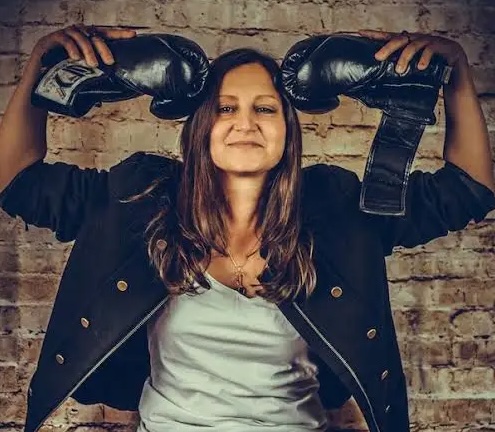
For over a century, Hollywood has been a powerful force in shaping global culture, but for Arabs, Muslims, and especially Palestinians, that power has often been used to erase or vilify. In a recent conversation, award-winning filmmaker Rolla Selbak, a queer Palestinian Muslim, unpacked her mission to decolonize the screen—a mission that has become even more urgent since October 7th.
The statistics paint a stark picture of exclusion. A 2021 study from the USC Annenberg Inclusion Initiative found that out of 200 popular films, 91% had no Muslim speaking characters at all . When they do appear, they are often relegated to harmful stereotypes. Jack Shaheen, a leading scholar on the topic, analyzed over 900 films and found that only 12 contained positive portrayals of Arabs or Muslims.
For Selbak, this erasure was personal. “I never thought in a million years that I’d be able to do it,” she said of filmmaking. “It’s not for me. It’s not meant for me. I’m only the audience. I’m not the creator.” This feeling of being an outsider in one's own story is a cornerstone of the colonial experience in media.
Selbak’s very existence in the industry is a political act. As a queer, Muslim, Palestinian woman, she embodies the intersectional identities that Hollywood has long ignored. Her 2011 film, Three Veils, which explored the lives of three young Middle Eastern women, including one who was a closeted lesbian, was groundbreaking. When asked how she reconciles being queer and Muslim, she is unequivocal: “I don’t think that there’s any reconciling for me. I don’t know what there is to reconcile really... It’s between you and the universe or you and the maker.”
This unapologetic authenticity is central to her mission. By telling stories that reflect the complex, nuanced realities of her communities, she directly challenges the one-dimensional caricatures that have dominated the screen. As Dr. Hani Chaabo, the podcast host, told her, “I wish, as a child I knew of you because it would’ve been so important for me to see that.”
Decolonizing cinema requires more than just telling different stories; it requires building new systems of support. Frustrated by the industry’s gatekeeping, Selbak founded the Sena Filmmaker Project, a free mentorship program for Palestinian filmmakers around the world. It’s a way to create the pathways for others that were never available to her.
This work has taken on a new urgency in the current political climate. In August 2024, over 65 Palestinian filmmakers signed an open letter accusing Hollywood of “dehumanizing” Palestinians and perpetuating racist tropes . Selbak has been at the forefront of this fight, using her platform to educate and advocate, despite the professional risks.
Her latest project, a Palestinian folk horror film called The Visitor, is another act of cultural reclamation. By centering Palestinian folklore in a popular genre, she is asserting the right of her culture to exist and be seen on its own terms, not as a footnote or a stereotype in someone else’s story.
From her DIY beginnings to her current role as a mentor and advocate, Rolla Selbak is not just making films. She is building a new cinematic landscape—one where Palestinians are not just the subjects of the story, but the authors of it.
[1] USC Annenberg Inclusion Initiative. (2021, June 10). Missing & Maligned: The Reality of Muslims in Popular Global Movies.
https://assets.uscannenberg.org/docs/aii-muslim-rep-global-film-2021-06-09.pdf
https://annenberg.usc.edu/news/research-and-impact/new-study-annenberg-inclusion-initiative-reveals-erasure-and-demeaning
[2] Variety. (2024, August 28 ). Palestinian Filmmakers Accuse Hollywood of 'Dehumanizing' Gaza.
•CNN. (2022, September 11 ). Muslims underrepresented on TV, study says.
https://www.cnn.com/2022/09/11/tv-shows/muslim-representation-television-study-trnd
•The Guardian. (2024, August 29 ). Palestinian film-makers sign letter protesting at Hollywood's inhumanity and racism.
https://www.theguardian.com/film/article/2024/aug/28/palestinian-film-makers-sign-letter-protesting-at-hollywoods-inhumanity-and-racism
•Shaheen, J. (Referenced in analysis ). How Stereotypes against Muslims and Arabs Have Transmitted from Early Orientalism to Hollywood.
https://janatermos14.medium.com/how-stereotypes-against-muslims-and-arabs-have-transmitted-from-early-orientalism-to-hollywood-dad5f738a105


.svg)


